
Understanding the readings
Why a humidifier raises PM2.5: water, mist and sensor readings
You switch on a humidifier, and soon the purifier increases its fan speed. PM2.5 rises on the display even though nobody has cooked, smoked or opened a window.
This is not necessarily a fault. The aerosol in the room, the measurement conditions, or both may have changed.
When an ultrasonic humidifier runs, higher PM2.5 can be associated with mineral particles from the water, droplets reaching the sensor and the effects of high humidity. It is also wrong to assume every increase is a harmless measurement error.
In this article
First cause: more than water is dispersed
An ultrasonic humidifier creates tiny droplets. If the water contains dissolved minerals, they can be dispersed with the aerosol. After the water evaporates, some of that material remains as particles.
White deposits on surfaces sometimes make their presence noticeable. However, no visible deposits does not prove an absence of mineral particles.
The EPA describes mineral dispersal by ultrasonic and some other humidifiers and recommends considering water quality. EPA humidifier guidance.
Second cause: the sensor is in the mist stream
Many household particle sensors estimate particles using light scattering. They do not analyse the chemical composition of each particle.
Mist aimed directly at a sensor can create conditions quite different from those elsewhere in the room. High relative humidity can also affect reading accuracy.
A number measured beside a humidifier nozzle therefore cannot automatically be treated as the average for the whole apartment. EPA Victoria explains optical sensor principles and limitations.
The opposite conclusion—“it is only detecting water, so everything is safe”—is unsupported too. Mineral aerosol and humidity-related effects can occur at the same time.
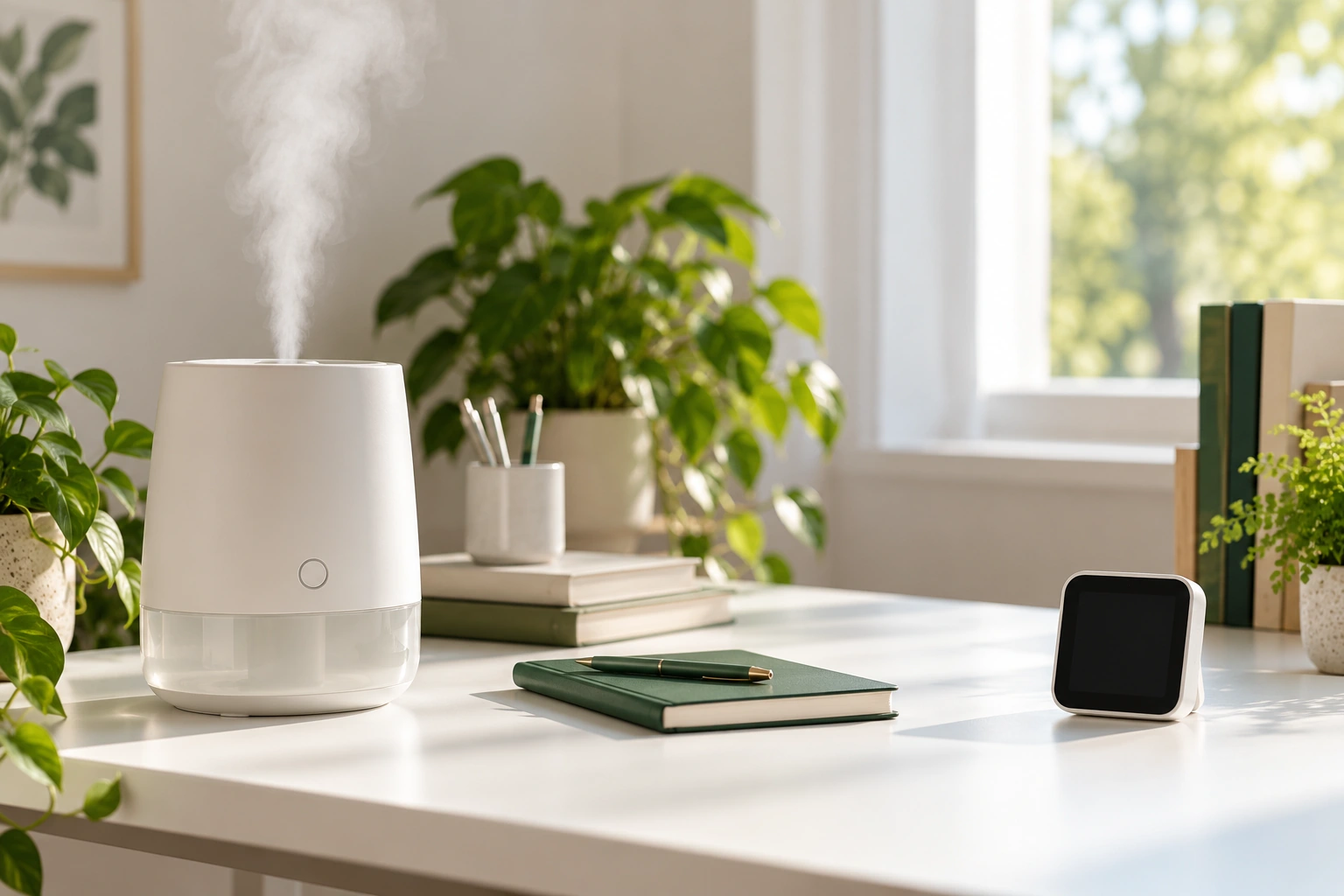
A step-by-step check
1. Stop humidification. Do not change every other condition at once. Record PM2.5 and humidity if you have a separate hygrometer. Do not deliberately increase concentrations to carry out a test.
2. Check the mist direction. Droplets should not enter the purifier’s intake or reach the filter, furniture or sensor. Use the instructions and actual mist direction to choose spacing.
3. Check the water requirements. With ultrasonic models, dissolved mineral content matters as well as whether the water is suitable for drinking.
4. Inspect the tank. Change the water and carry out the care specified by the manufacturer. Do not keep topping up old water indefinitely.
5. Assess normal operation after corrections. Compare readings with the original conditions. If the problem repeats, consult the instructions and the appliance support teams.
A fall in readings after switching off humidification does not by itself identify the exact cause. It is an observation that helps narrow the search.
Is boiled or filtered water suitable?
Boiling is not distillation. Ordinary boiling does not guarantee low-mineral water: dissolved salts can remain.
“Filtered” is not specific enough either. A filter jug and a reverse-osmosis system work differently; the result depends on the system and its maintenance.
The EPA notes that distillation effectively reduces mineral content. Choose water according to the humidifier instructions and its actual composition. Distilled water does not remove the need to clean the tank or guarantee that the whole system is sterile.

Should the purifier be switched off?
Do not disable filtration merely to make the displayed number look better. First address direct mist exposure, water and humidity.
A purifier should not continuously compensate for inappropriate use of a neighbouring appliance. If its casing or filter becomes wet, stop using that arrangement and follow the safety instructions.
The built-in PM2.5 display on GL-K180 helps observe changes, but it does not replace a hygrometer or identify the aerosol’s chemical composition.
Does an evaporative humidifier have the same issue?
It produces moisture differently. The EPA notes that evaporative and steam models generally disperse substantially fewer minerals. Every type still requires care and humidity control.
What if PM2.5 rises without a humidifier?
Check cooking, incoming outdoor air, other particle sources, and sensor location and maintenance. Do not attribute a persistent increase solely to humidity. EPA on factors affecting household monitor accuracy.
The aim is to identify the cause and improve conditions, rather than force the sensor to show a lower number at any cost.