
Your home in the heating season
Air purifier or humidifier: what to choose during the heating season
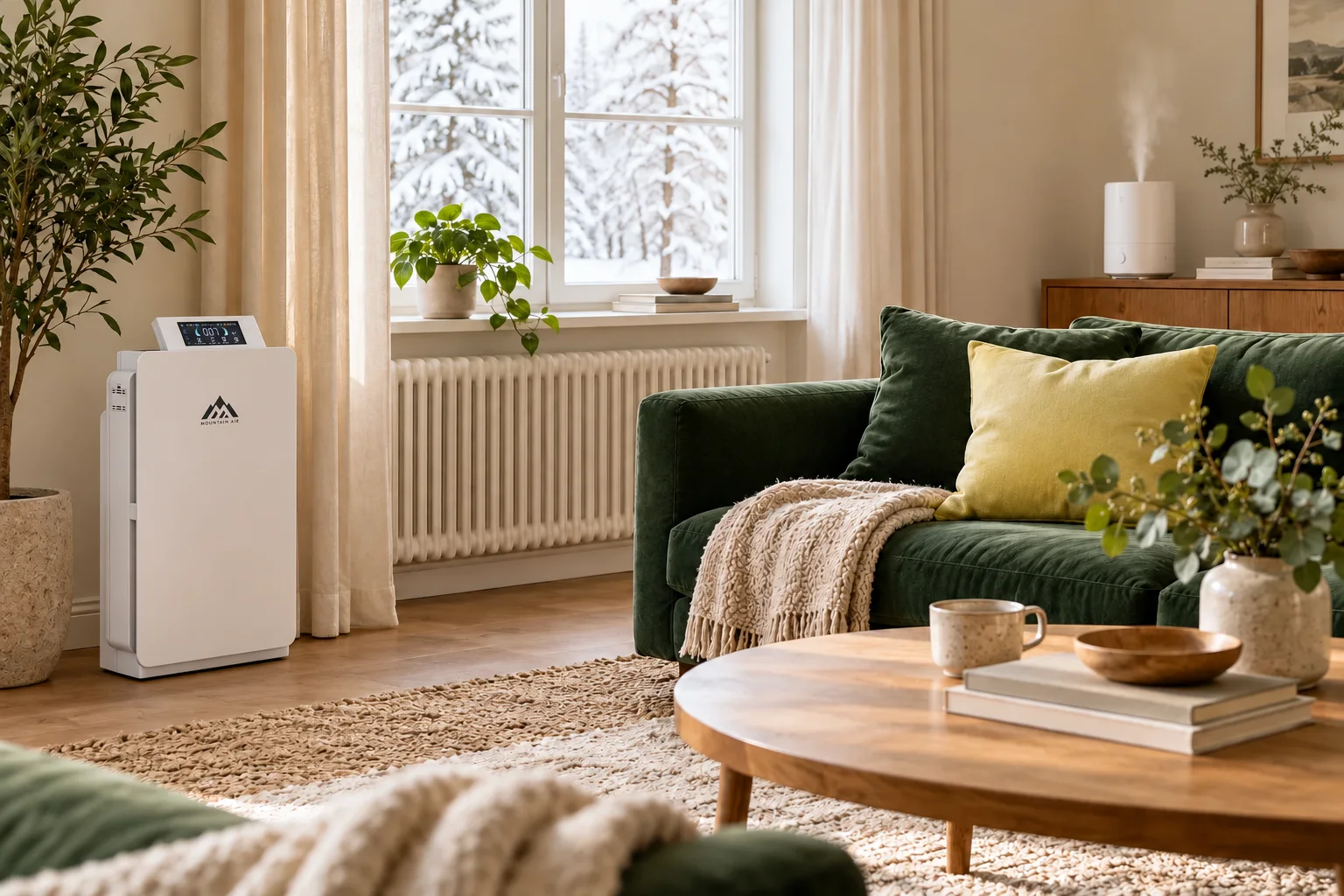
The radiators are warm, the windows are opened less often, and you wish the air at home felt fresher. Dust reappears on the furniture, clothes build up static, and the bedroom feels stuffy in the evening. It is tempting to see all of this as one problem that a single appliance should solve.
But dryness, dust and stuffiness have different causes. Even a good appliance can disappoint if you expect it to do the wrong job.
Why indoor air becomes dry in winter
People often say that radiators “burn up moisture.” For an ordinary hot-water heating system, that is not quite the right explanation.
During cold weather, outdoor air enters the home through ventilation, windows and gaps. When it warms up without additional water vapour, its relative humidity falls. High outdoor humidity therefore does not necessarily mean that airing out a warm room will make it more humid.
A household hygrometer measures relative humidity, usually as a percentage. The US National Weather Service explains its relationship with temperature.
However, the heating season does not make every home the same. One may genuinely lack moisture, while another has condensation on its windows. It is better to choose a solution based on measurements than on the calendar.
What to choose: a quick reference
| What is happening at home | Where to start |
|---|---|
| The hygrometer consistently shows low humidity | Assess whether humidification is needed |
| Airborne dust, pollen or smoke particles are a concern | Address accessible sources and choose suitable filtration |
| Humidity is adequate, but the room feels stuffy | Check temperature and air exchange |
| The air is both dry and polluted with particles | Consider using two separate appliances |
| There is condensation on windows or wetness near the humidifier | Reduce humidification and investigate the source of moisture |
You do not necessarily need to buy two appliances at once. First, identify the particular problem in your room.
When you need a humidifier
A humidifier adds water to the air. Judge its performance by humidity readings, rather than the size of a visible cloud.
Start with a hygrometer: check the readings morning and evening over several days. Do not place it directly beside a radiator, a cold window or in the mist stream. Otherwise, you will be measuring one small spot rather than typical conditions in the room.
Household guidance often suggests a relative humidity range of 30–50%. That does not mean you should reach the upper limit at any cost. In freezing weather, condensation may develop on cold surfaces sooner: window condition, insulation and ventilation all matter. See Health Canada’s guidance on moisture control.
If water appears on the glass and surfaces near the appliance become wet, do not turn the output up. The aim is to maintain suitable conditions, rather than add as much moisture as possible.
When you need an air purifier
An air purifier passes room air through filter elements. Suitable HEPA filtration helps capture airborne particles, while sorbent materials are used for some gaseous pollutants and odours.
Filter names are not the only consideration. Performance should match the room, and the appliance should be able to do its job at a speed you are willing to use regularly.
A purifier does not wipe dust off a windowsill or collect pet hair that has already settled on a sofa. Cleaning is still necessary. Filtration supplements source control and ventilation rather than replacing them. See the EPA guide to air cleaners in the home.
A humidifier does a different job. Even if the air feels more pleasant after you switch it on, that alone does not demonstrate a reduction in pollutants.
Why a room may still feel stuffy
Imagine a bedroom: the door is closed, the windows have not been opened, and people have been inside for several hours. The purifier is running, PM2.5 readings are low, yet the room still does not feel fresh.
There is no contradiction. Particle concentration and air exchange are different parameters.
An ordinary household air purifier does not remove the CO₂ produced by breathing. Humidification does not solve this problem either. Outdoor air needs to enter the room. Specialists at the University of Melbourne explain this distinction.
In a city affected by smog, airing should take outdoor conditions into account. However, keeping windows permanently closed cannot be treated as a complete substitute for ventilation.
Can you use an air purifier and a humidifier together?
Yes, if both needs are present and the appliance instructions allow this use.
The key is not to turn them into a single installation by directing mist straight into the purifier’s air intake.
Position the appliances so that:
- droplets do not reach the casing, filters or electrical components;
- furniture and textiles around the humidifier remain dry;
- the purifier’s air inlet and outlet stay clear;
- sensors are not directly in the mist stream.
There is no universal distance suitable for every pair of models. Follow their instructions and consider the actual direction of the airflow.
There is also a less obvious detail. An ultrasonic humidifier can disperse minerals contained in its water. This may be accompanied by white dust and higher particle sensor readings. A rise in readings therefore should not automatically be interpreted as a purifier fault. The EPA recommends considering the water’s mineral content and the humidifier’s maintenance requirements. Read more about this mechanism.
A purifier should not be expected to compensate for unsuitable water or a dirty tank in a neighbouring appliance.
Two homes, two different solutions
These are hypothetical examples, not test results.
The first home. Humidity stays around 25% for several days, and dryness is the main complaint. It makes sense to address humidification first. Buying a purifier solely to raise humidity will not solve that problem.
The second home. Humidity is around 45%, but PM2.5 rises after cooking and smoke particles enter from outdoors. Adding water does not eliminate the pollution source. Checking extraction, airing practices and suitable filtration matters more.
A third situation is also possible: too little moisture and too many particles at the same time. That calls for coordinated action rather than a search for one “most powerful” setting.
How to keep useful appliances from becoming a burden
Before buying, consider maintenance as well as features.
For a humidifier, that means changing the water regularly, cleaning the tank and following the care instructions. Do not keep topping up old water indefinitely. Health Canada highlights regular maintenance as an important part of safe use.
For a purifier, it means checking the pre-filter, replacing consumables on time and keeping the airflow clear.
A convenient appliance is one you can use properly throughout the season, rather than only during the first week.
What MOUNTAIN AIR GL-K180 does
MOUNTAIN AIR GL-K180 is specified with HEPA H13, carbon filtration and a PM2.5 sensor. In the system discussed here, it handles air cleaning, but it is not a humidifier.
If humidity in the room is too low, it needs separate monitoring. PM2.5 readings do not replace humidity measurements or an assessment of ventilation.
Frequently asked questions
Does an air purifier dry out the air?
An ordinary filtering purifier is not designed to dehumidify. If the air feels drier after switching it on, check humidity and temperature: sensations alone cannot establish the cause.
Can I just use a humidifier if my home is dusty?
Humidification does not replace cleaning or suitable particle filtration. First identify where the dust comes from and whether it is airborne or has already settled on surfaces.
Which should I buy first?
Choose what addresses a confirmed problem. For low humidity, consider humidification. For particle pollution, focus on source control and cleaning the air. For insufficient air exchange, address ventilation.
What to remember
In winter, you do not need to choose between “humid” and “clean” air. You need to understand what your room is missing.
A humidifier manages moisture. A purifier addresses pollutants. Ventilation provides air exchange. A good result starts with assigning these tasks correctly.